Why Progress Isn’t Linear And Other Lessons I Learned Playing Darts

Have you ever picked up a new hobby expecting a distraction, only to walk away with unexpected lessons?
Last autumn as the outdoor temperatures gradually dipped and daylight hours shorten, I inwardly dread the coming of winter. Still adapting to a lifestyle that changes with the seasons in New Zealand, I find myself reluctant to spend too much time in the cold. While some suggest that winter is a season to slow down, rest and recover, it felt like an opportunity to explore something new instead.
Lo and behold, my wife came across a community post online calling for players to join a social darts competition. I have always had an interest in darts, dabbling in it once in a while back in Singapore. Making a bold decision, I registered for the competition and ventured into the world of darts despite having very limited experience.
Over the next four months, not only have I become a better player, the competition taught me several transferrable insights into my personal and professional life.
Join me as I explain the game of darts, and reflect on my personal takeaways from the competition.
Understanding The Game
For those unfamiliar with darts, one of the most common game is the 501. The objective is to reduce your score from 501 to zero points faster than your opponents, using three darts per turn. Referring to the image of the dartboard below, the scoring areas are as indicated.
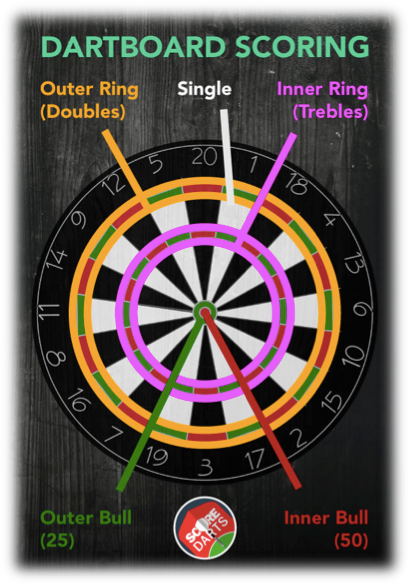
Each slice of the board is numbered from 1 to 20. There are two rings on the board, the outer ring doubles the score while the inner ring triples it.
Contrary to popular belief, the bullseye isn’t the highest scoring area to aim for. Instead, it is the inner ring (trebles) for the 20 point section, which is worth 60 points compared to the bullseye (50 points)!
As your score is deducted from 501, there’s an important rule to finish the game: your final dart must land on a double and bring your score exactly to zero. For example, with 40 points remaining, you can finish by hitting double 20. If you score more than your remaining points, you go “bust” and must try again next turn with the same score.
Trust me, ending a game as a beginner can be frustrating when accuracy depends more on luck than skill.
With the basics ironed out, how does one begin on a journey towards excellence?
Small Habits, Long Term Gains
In this day and age, it may not be surprising to discover that there is already a technological solution to a problem or a shortcut to accelerate progress. Perhaps, there is a secret formula to get us to where we want without the struggle and difficulties.
Like any enthusiastic beginner, I researched and tried a variety of training routines, hoping to find a secret programme or dart setup that would drastically improve my throwing. Much to my dismay, and maybe yours too, a journey towards excellence begins by getting the basics right – a proper stance accompanied by a sturdy and consistent throwing motion refined through repetition.
Using the bamboo plant as an analogy, growth often appears invisible at first. For years, the bamboo develops its root system underground consistently, creating the stability required for rapid growth later. Without those deep roots, the plant wouldn’t be able to support its sudden vertical rise.
The day-to-day grind can feel monotonous, but the effects of consistency compound over time. Interestingly, neglect compounds too. Consider the long-term impact of consistently lacking sleep or a balanced diet.
The focus has often been on compounding the benefits we want. Are there negative effects that you might be compounding without realising? How would you then redesign your daily habits?
The Non-Linear Nature Of Growth
A common misconception with progress is that it is linear and predictable. The more effort you invest in whatever you are doing, the better the outcome is consistently. Unfortunately, that is far from the truth.
When I first picked up darts, simply hitting the board was a challenge. As my accuracy improved, my scoring average increased. However, as I started aiming more frequently for the 20-point section, any slight deviation would land on a 1 or 5 instead, causing my average to dip temporarily. This is a familiar plateau for amateur players, one that only improves with further precision and practice.
A similar concept exists in fitness training, often referred to as “beginner gains.” Early progress comes quickly as the body adapts, followed by a period of stagnation once adaptation occurs. Continued growth requires patience, consistency, and often a change in approach.
Growth and improvement are not linear. Expect stagnations and even regressions at times. The key is not to give up, stay disciplined and be willing to try different approaches.
Different Paths, Same Game
As I played against different competitors, I noticed that each person has their own approach to the game of 501. Some aim for the 19s instead of the highest scoring 20 point sections. One of my team members’ forte was the 14s, which is an unconventional choice due to its lower scoring potential.
Despite that, his high accuracy for the 14s often empowers him to score consistently and win games in unorthodox ways. When behind, he relied on the 14s to regain momentum. When out of rhythm, he used it to re-centre his aim before returning to higher targets.
This brings home the point that everyone’s journey is different. Each of us have our own preferences, strengths and unique perspectives. So don’t succumb to the pressure of trying to blend in or to be similar with others. Instead, express your character and uniqueness confidently.
What are your strengths and how can you leverage on them to tackle the challenges standing in your way?
Keeping The End In Sight
If you play darts, you will know that ending a game is the hardest part. Initiating a game is the easy, but closing with a double requires precision and strategy.
The same applies to many personal and professional pursuits. Gym memberships are often signed up for with enthusiasm, only to be underutilise months later. At work, projects may launch with excitement but stall once resistance emerges or novelty fades.
Although each scenario comes with their own set of difficulties, committing to an end goal that resonates can increase personal motivation, improving the odds of seeing through what you started. Equally important is knowing specifically what it takes to reach the finishing line.
In the case of darts, committing to finish a game not only means victory, but it allows players to track metrics such as averages and closing percentages. These metrics are easy to measure, compare and highly personal. To improve, training naturally focuses on improving your scoring efficiency and hitting the doubles consistently.
Determining what you want to achieve for yourself, and identifying the specific steps and efforts to get you there can help you start and finish meaningful pursuits.
Concluding
Putting it all together, develop clarity and purpose before you embark on a new experience. Recognise that everyone’s journey can be different, and don’t be discouraged when progress isn’t visible. Stay committed to getting the foundations right, leverage your strengths and be adaptable to the ever changing landscape while staying laser focused on the finishing line.
It’s interesting how much insight one can come from picking up a new hobby.
It’s your turn now. What interesting hobbies do you have? It is time to have fun, while discovering insights you can apply to daily life!