Implications of AI and the Future of Governance (New Zealand Context)

In the beginning of 2026, I made a commitment to further my personal development in the governance space, embarking on a new learning journey with the Chartered Governance Institute of New Zealand. The course, International Chartered Governance Programme (ICGP), comprises of 6 modules that aims to instil a deep understanding of corporate governance principles, strategy, finance, law, risk management and Boardroom dynamics.
I envision that in the next phase of my career in the water industry, the knowledge and application of governance principles will be essential as I pivot from operations into senior leadership and strategic roles in the coming years. This is especially applicable in New Zealand, where 3 Waters infrastructure ownership and governance is undergoing a huge transformation driven by the introduction of the Local Water Done Well policy late 2023.
Over the ICGP course, there will be multiple graded assignments that helps me cement my understanding and application of the governance principles. As such, I wish to share my reports on my blog with the goal of documenting my progress towards becoming a chartered professional while raising awareness on governance frameworks with my readers. I believe that these are transferrable skillsets that spans across industries and can potentially be of benefit in expanding the breath of your thinking and perspective taking.
As such, this post marks the first assignment for my Corporate Governance module, where the Board Chair (of my hypothetical company) has tasked me with providing a formal board paper to the Board to consider the implications of the future of governance and the impact of AI, both for the Board and for the organisation.
*Disclaimer: This paper was prepared as part of an academic assignment. The views, analysis, and recommendations presented are my own and do not reflect the positions of my employer or any affiliated organisations. The content is intended for learning and discussion purposes only, and should not be taken as professional advice.
Attention: Board of 3 Waters Council Controlled Organisation (CCO)
Board Paper: Implications of AI and the Future of Governance
Drafted By: 3 Waters CCO Board Secretary
Executive Summary
With our newly established 3 Waters CCO, we are strategically positioned to build a governance framework that enables sustainable service delivery and agile adaptation to advancing AI technologies.
This paper examines New Zealand's (NZ) governance landscape and emerging governance models nationally and internationally, providing a foundation for the Board to critically evaluate the CCO's governance framework and future readiness. Significant attention is given to AI governance and barriers to adoption, equipping the Board with insight into the risks and opportunities AI presents.
The integration of AI governance is assessed as beneficial, leveraging objectivity and process automation. Recommendations address how the Board Secretariat can guide:
• Building AI literacy across the Board and CCO in the near term
• Structured AI governance integration over the long term
Globally, governance expectations for infrastructure heavy organisations are rapidly evolving. It is timely for the Board to consider how AI can transform the CCO's governance framework to deliver compliant, sustainable 3 Waters services while maintaining high transparency and accountability to local Councils and ratepayers.
Organisational Context and Purpose of the Paper
Water governance in New Zealand is politically sensitive due to competing stakeholder interests among local Iwi, and local and central government, as water is both a public and cultural resource (Challies & Tadaki, 2022). These competing interests produce institutional complexity around financial sustainability and decentralised governance structures (Moridnejad et al., 2025).
The Local Water Done Well (LWDW) policy, introduced by the New Zealand Coalition Government in December 2023, underpins the latest reform of 3 Waters infrastructure ownership and management (New Zealand National Party, n.d.). With the Local Government (Water Services) Act 2025 receiving Royal Assent, our CCO has been established to deliver sustainable infrastructure investment and environmental compliance while managing community expectations (Dentons, 2025). The Board operates under a public utility governance framework, overseeing public value delivery to ratepayers and maintaining accountability to local councils as shareholders.
The public utility model is a hybrid between agency and stewardship theory. Agency theory recognises the principal (councils) and agent (the Board) relationship, where governance mechanisms are required to align the Board's decisions with the councils’ interests (Jensen & Meckling, 1976). Stewardship theory complements this by framing the Board members as stewards who act in the CCO’s long-term interest rather than for personal gain, highly applicable to a public utility where community outcomes outweigh profit motives (Davis et al., 1997).
Globally, rapid AI development in the 3 Waters sector outpaces governance adaptation (Doorn, 2020; Takeda et al., 2021), introducing regulatory and ethical uncertainties as algorithmic decision-making displaces traditional human-centric models. The Chair has therefore requested this paper to analyse the future of water governance in New Zealand and how the CCO can capitalise on AI while implementing adequate controls to manage its risks.
New Zealand's Changing Governance Landscape
To effectively analyse the future of water governance, an assessment of New Zealand's governance landscape and its changing trends sets the stage for later discussion. In Table 1, we identify four developing governance themes in New Zealand and what they mean for the Board.
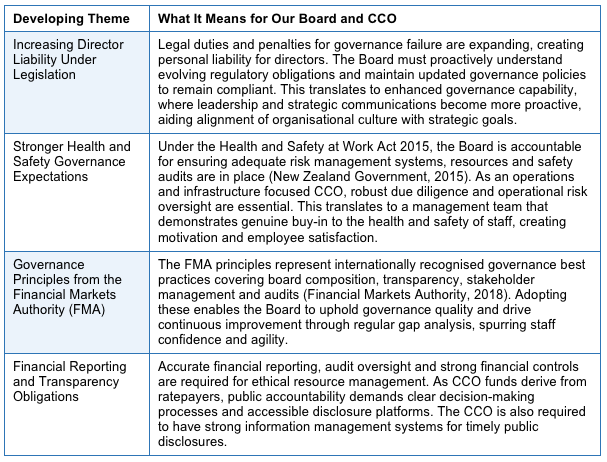
According to Martyn (2013), the current governance landscape is described as being in "white waters", illustrating the dynamic, fast-changing environment around governance not just in New Zealand, but globally. From the four developing trends in Table 1, the expectations and responsibilities of the Board are not only expanding but growing in complexity. These developments require the Board to adopt a growth mindset for continued learning and up-skilling, to be forward-looking in anticipating changes, and to embrace organisational agility. Without this, governance practices within the CCO risk losing their strategic edge, potentially leading to operational inefficiencies, regulatory non-compliance and poor infrastructure investment decisions.
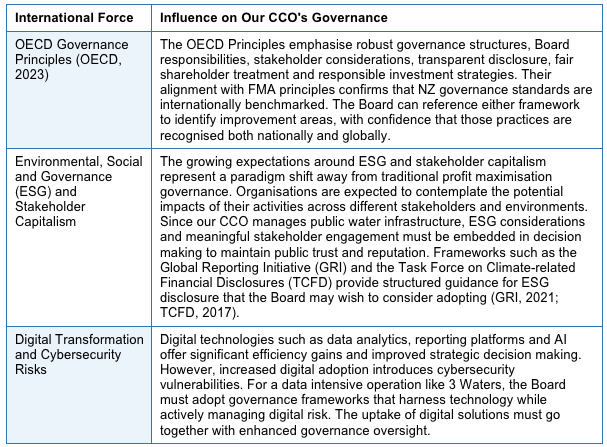
After emphasising the importance of being anticipatory around governance developments, let us expand our discussion to look at what is happening abroad that might strongly affect governance practices in New Zealand.
International Forces Influencing Governance
Traditional and Emerging Governance Models
Having analysed the developing themes in governance practice both locally and internationally, let us explore the different traditional and emerging governance models discussed in the literature. There are opportunities to integrate insights derived from both the developing themes and emerging models into the CCO's current governance framework. Doing so empowers the Board to respond swiftly to current and emerging developments.
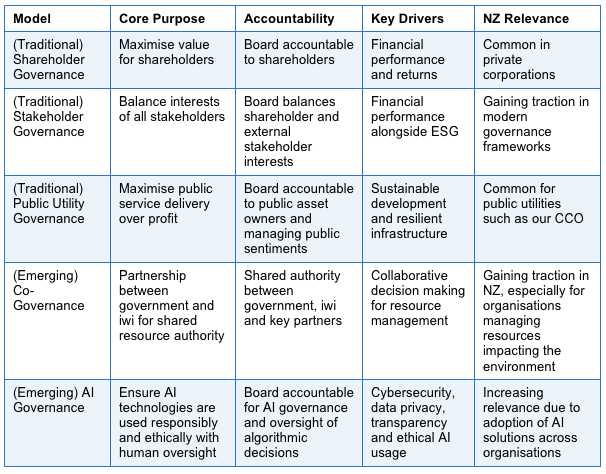
Our 3 Waters CCO adopts the public utility governance model, commonly described as a hybrid of the shareholder and stakeholder governance models, where the Board is accountable to the asset owners while managing the interests of a variety of stakeholders, including ratepayers and central government.
Co-governance is an emerging governance model that is highly applicable to New Zealand due to the country's historical and cultural background around the ownership and management of natural resources such as water. Specifically, the principles of Te Tiriti o Waitangi establish a partnership obligation between the Crown and Māori. Co-governance structures such as joint resource management entities represent a practical expression of this obligation (Local Government New Zealand, 2023). The 3 Waters context is directly tied to Māori concepts of kaitiakitanga (guardianship) and tino rangatiratanga (self-determination), making co-governance not merely a strategic option but a Treaty obligation the Board must actively consider (Tipa & Tierney, 2006).
Linking back to developing themes around ESG considerations and stakeholder engagement, there is strategic merit for the Board to establish formal partnerships with local Iwi and key technical professionals. From my experience as Board Secretariat, local Iwi groups possess strong cultural and traditional understanding of sustainable natural resource management. Their perspective is principally different from that of the scientific and academic community. For local or district level CCOs like ours, these skills and capabilities may not be present in our current organisation. It is therefore recommended that the Board explores means to establish long-standing formal partnerships through a steering committee to facilitate collaborative decision making for specific business aspects, or a routine consultation arrangement to seek strategic advice and guidance.
By incorporating co-governance principles into current governance practices, the Board facilitates stakeholder involvement and transparency, while leveraging key expertise outside our current skillsets to further the CCO's ESG pursuits.
AI Governance and Implications for the Board
Linking back to Table 3, AI governance is an emerging governance model that is increasingly relevant to our CCO due to the rapid availability and adoption of AI technologies across business functions. It is timely for the Board to examine this model and understand potential implications so that sufficient controls can be designed and implemented to maximise benefits while minimising the inherent risks.
Fundamentally, AI makes swift algorithmic decisions based on the rules and principles it is designed with. For our CCO, AI use would primarily focus on operational optimisation through predictive analytics. This translates to cost savings from reduced chemical and energy usage. Additionally, predictive analytics are said to reduce equipment failures by prompting preventive maintenance and stocking of critical inventory, reducing operational downtime (Sit et al., 2020). Predictive analytics could also enable better stormwater management by anticipating weather forecasts and preemptively directing flows to increase conveyance and storage volumes (Doorn, 2020).
Administratively, AI tools have empowered business functions to collate and analyse data seamlessly, automating reporting and certain levels of decision making within organisations. This can include risk management and resilience planning, often a tedious process due to the consideration of wide ranging data points and their complex interactions (Doorn, 2020).
However, AI effectiveness is only as good as the rules it operates by. A key requirement for effective AI use is adequate governance to ensure utility remains responsible and transparent. AI governance determines boundaries for how AI tools can be used across the organisation, aiming to achieve ethical and compliant use, coupled with an ongoing process to review and improve AI utility to enhance value creation and delivery. The Board will require familiarity with AI tools and trends, and openness to seek guidance from external professionals to inform decision making around AI adoption.
If governance is inadequate, several implications could arise. When decision authority shifts from people to AI tools, algorithmic decisions may not accurately reflect the CCO's objectives (Katzenbach & Ulbricht, 2019). For a CCO where public services and environmental outcomes are directly correlated with operational decisions, poor algorithmic decisions without proper supervision can easily lead to reputational and financial harm. Furthermore, over-reliance on AI can lead to organisational complacency. Without appropriate human oversight, staff interaction with tools decreases after the adoption phase, encouraging over-dependence on AI outputs and resistance to validate their accuracy.
Barriers to AI Adoption in Governance
One of the key challenges in AI adoption lies in its incompatibility with existing regulatory frameworks, where governance models lack structure and guidance for algorithmic systems (OECD, 2023). Concerns arise around how fairness, risk assessment and ethics can be adequately maintained while using AI. It is ideal for the Board to have platforms for open discussion to explore continuous improvements, making the co-governance principles discussed earlier particularly beneficial.
The second barrier, in the context of our CCO, is data quality and availability. The effectiveness of AI's algorithmic systems depends directly on the quality of data they receive (Sit et al., 2020). Our fragmented and ageing water infrastructure has limited data availability and consistency. Without clean data, it is difficult for AI systems to make accurate decisions suited to our operating conditions. Information systems and data infrastructure upgrades must therefore take priority if we wish to maximise the benefits of AI technologies.
Third, inadequate organisational capability around AI systems and cybersecurity poses a significant challenge to successful adoption (Birkstedt et al., 2023). This applies to the Board as much as to staff. Without adequate expertise, identifying gaps in AI systems and governance processes becomes difficult, leaving the CCO vulnerable to cybersecurity risks and compliance failures. It is key to empower the Board and CCO staff with opportunities to develop technical expertise around AI, ensuring a competent and relevant workforce.
Lastly, a lack of transparency and clarity around how AI systems operate can jeopardise trust and accountability when generated outcomes come under scrutiny (Katzenbach & Ulbricht, 2019). Different AI systems operate uniquely due to their software composition and data feed. For the layperson, doubt arises when strategic and operational decisions are determined by AI algorithms. For our CCO, where decisions are publicly communicated and accountable to a wide range of stakeholders, adopted AI systems must have auditable, understandable decision making processes with clear human oversight for quality assurance.
Strategic Recommendations
Having explored the common challenges in adopting AI, the Board requires a practical and internationally recognised approach to facilitate a smooth adoption process. I propose the National Institute of Standards and Technology (NIST) AI Risk Management Framework, which balances clear accountability and oversight with transparency and swift innovation (NIST, 2023). This is achieved through four key functions: Govern, Map, Measure and Manage. The framework operates as a continuous loop, and can run concurrently whether the Board is onboarding a new AI system or reviewing policy for an existing one.
Recommendations are structured across two time horizons. Short-term recommendations (within 12 months) focus on building governance foundations, AI literacy and developing policy. Long-term recommendations (12–36 months) focus on embedding AI governance into the CCO's enterprise risk and audit processes, piloting AI systems, and scaling adoption based on evidenced outcomes. The Board Secretariat will support both horizons through facilitation, coordination and reporting.
Govern (Short-Term)
The Govern function focuses on establishing strategic direction and governance processes anchored around AI adoption. In the short term, the Board should place AI on Board agendas and assign oversight to the existing Enterprise Risk Management (ERM) committee. The ERM committee is well-positioned for this role, as adoption risks spanning data governance, cybersecurity, infrastructure resilience and operational efficiency directly relate to their mandate. The committee's analysis will contribute to the formation of policies that define clear roles, responsibilities and decision-making processes for AI use.
As Board Secretariat, I will work closely with the Board and ERM committee to facilitate AI discussions at the strategic level, aligning AI use with the organisation's purpose. I will coordinate controlled implementation of newly drafted policies across the CCO and work with Human Resources to identify training opportunities to enhance AI literacy, fostering a conducive AI culture throughout the organisation.
Map (Short-Term)
The Map function focuses on identifying an inventory of specific AI use cases and the desired value creation within the CCO. The objective is to ensure that AI systems are deliberate and Board-approved so that accountability and risk controls are established early and adequately. Management, with its technical expertise, can take stock of current AI use or propose best fit use cases for specific business functions. The Board oversees the overall governance process and can also direct implementation of certain AI systems to achieve synergy across functions. Critically, identifying affected stakeholders and potential impacts for each AI system enables targeted controls to be developed, ensuring stakeholder expectations are considered and trust is maintained.
As Board Secretariat, I will research and recommend emerging AI systems to the Board for consideration, and coordinate the inventory development process, facilitating reporting and documentation of decisions around AI adoption and their respective accountability structures.
Measure (Long-Term)
The Measure function emphasises determining the effectiveness of risk controls and governance policies implemented for each adopted AI system. This is achieved using quantifiable measures such as KPIs, or qualitative measures such as stakeholder surveys and feedback. The intention is a structured rollout of AI systems with risk controls, followed by review for continuous improvement. Best practice includes piloting AI systems in test environments before full deployment, once reliability and security are confirmed.
I will assist the Board in setting performance measures and risk controls with different business functions in the CCO, presenting outcomes routinely. This supports Board discussions around the type and pace of AI adoption and risk management to avoid operational and governance surprises.
Manage (Long-Term)
The Manage function integrates AI usage into existing governance and organisational processes, including ERM, monitoring and review, and audit and reporting. AI integration promotes continuous oversight, review and intervention when controls prove inadequate or stakeholder expectations evolve.
As in my earlier responsibilities, I will support the Board by coordinating performance reports around AI usage. By ensuring information flows timely from business functions through Management and to the Board, strategic oversight is maintained and well informed decisions around AI governance can be made for the CCO.
Conclusion
This paper has explored New Zealand's governance landscape and discussed emerging trends locally and internationally. Underpinned by agency and stewardship theories, the CCO's public utility model provides a strong governance foundation, which can be further strengthened through incorporating co-governance principles that honour Te Tiriti o Waitangi obligations. Recognising that AI advancement brings significant potential to improve work related processes and efficiencies for the CCO, governance risks and barriers to adoption have been identified and analysed. Phased recommendations short and long term horizons have been proposed for the Board to review and approve. As Board Secretariat, I will actively guide and support the Board throughout the decision-making and implementation process. Ultimately, it is our combined interest to ensure the CCO can responsibly leverage AI for the betterment of the environment and the communities we serve.
References
Birkstedt, T., Minkkinen, M., Tandon, A., & Laine, M. (2023). AI governance in practice. AI & Society.
Challies, E., & Tadaki, M. (2022). New horizons in the politics of water governance. New Zealand Geographer, 78(1), 3–8. https://doi.org/10.1111/nzg.12332
Davis, J. H., Schoorman, F. D., & Donaldson, L. (1997). Toward a stewardship theory of management. Academy of Management Review, 22(1), 20–47.
Dentons. (2025, August 26). The third and final Local Water Done Well Bill receives Royal Assent. https://www.dentons.co.nz/en/insights/articles/2025/august/26/the-third-and-final-local-water-done-well-bill-receives-royal-assent
Doorn, N. (2020). Artificial intelligence in the water domain: Opportunities for responsible AI. Environmental Science & Policy, 107, 1–8.
Financial Markets Authority. (2018). Corporate governance in New Zealand: Principles and guidelines.
https://www.fma.govt.nz/assets/Reports/180228-corporate-governance-handbook-2018.pdf
Global Reporting Initiative. (2021). GRI universal standards. https://www.globalreporting.org/standards/
Jensen, M. C., & Meckling, W. H. (1976). Theory of the firm: Managerial behavior, agency costs and ownership structure. Journal of Financial Economics, 3(4), 305–360.
Katzenbach, C., & Ulbricht, L. (2019). Algorithmic governance. Internet Policy Review, 8(4).
Local Government New Zealand. (2023). Co-governance and the Treaty of Waitangi: A guide for local government.
https://www.lgnz.co.nz
Martyn, K. (Ed.). (2013). Corporate governance: A practical handbook (2nd ed.). CCH New Zealand.
Moridnejad, M., et al. (2025). The three waters reform in New Zealand: Learning from local government narratives for improved governance. Water Policy.
National Institute of Standards and Technology. (2023). Artificial intelligence risk management framework (AI RMF 1.0). U.S. Department of Commerce.
New Zealand Government. (2015). Health and Safety at Work Act 2015.
New Zealand National Party. (n.d.). Local water done well. https://www.national.org.nz/policies/local-water-done-well
Organisation for Economic Co-operation and Development. (2023). G20/OECD principles of corporate governance. OECD Publishing. https://www.oecd.org/en/publications/g20-oecd-principles-of-corporate-governance-2023_ed750b30-en.html
Sit, M., Demiray, B. Z., Xiang, Z., Ewing, G. J., Sermet, Y., & Demir, I. (2020). A comprehensive review of deep learning applications in hydrology and water resources. Water Science and Technology, 82(12), 2635–2670.
Takeda, T., Sakai, H., & Nishikawa, T. (2021). Governance of artificial intelligence in water and wastewater management. Water, 13(3), 120.
Task Force on Climate-related Financial Disclosures. (2017). Recommendations of the Task Force on Climate-related Financial Disclosures.
https://www.fsb-tcfd.org/publications/final-recommendations-report/
Tipa, G., & Tierney, L. (2006). Cultural mapping tools for freshwater governance. Ecology and Society, 11(1).