Was Theranos Just Fraud Or a Much Deeper Governance Failure?


This post forms a series of papers and assignments I have prepared for my education under the International Chartered Governance Programme (ICGP) at Chartered Governance Institute of New Zealand. The context for my latest professional development can be found in my earlier post.
In this post, I have developed a Board paper as Fisher and Paykel Healthcare’s board secretary to draw insights from the failure of Theranos and inform the Board about strategic thinking on governance and organisational risk and the emerging role that shareholders may play in good governance.
*Disclaimer: This paper was prepared as part of an academic assignment. The views, analysis, and recommendations presented are my own and do not reflect the positions of my employer or any affiliated organisations. The content is intended for learning and discussion purposes only, and should not be taken as professional advice.
Attention: Board of Fisher and Paykel Healthcare
Board Paper: Beyond Fraud: What the Theranos Collapse Reveals About Governance
Drafted By: Fisher and Paykel Healthcare Board Secretary
Executive Summary
Our Chair, Mr Neville Mitchell had requested for this Board paper to examine the prolific case of Theranos from the United States. The paper focuses on identifying lessons for Fisher & Paykel Healthcare (F&P) around governance and organisational risk management in an environment where shareholder and stakeholder participation is growing in importance. Although the collapse of Theranos is often alluded as intentional fraud by founder Elizabeth Holmes, the case provides valuable governance failure insights. This presents an opportunity for F&P, operating within the same healthcare industry which demands strict scientific validity and regulatory compliance to review our current governance practices and re-evaluate its robustness.
Key relevant insights derived from examining the case of Theranos includes: Inadequate Board composition and performance, Lack of transparency and information flows, Lack of risk governance, and Failure of organisational culture and ethics. The paper then provides a comparative governance analysis of F&P’s current practices using the principles from ASX and NZX Corporate Governance Code (ASX Corporate Governance Council, 2019; NZX, 2023). This process identified three key areas of strengthening for F&P: Organisational culture and development, Engagement of shareholders and stakeholders and Enterprise risk management. Actionable recommendations facilitated by the Board Secretary across both short and long term horizons are proposed for the Board’s consideration.
Introduction & Context
This paper presents the Board with governance insights derived from the case study of Theranos, evaluate governance risks relevant to F&P, and identify potential leverages on emerging shareholder roles.
Despite the importance of delivering trustworthy and dependable healthcare services, corporate governance in healthcare firms are underdeveloped or received lesser focus compared to their financial counterparts (Szabó, 2021). In the report by Transparent International (2016), negative patient outcomes are often caused by weak governance and lack of transparency in the healthcare sector. On the flipside, the empirical study by Becheș (2025) showed strong correlation between Boards with strong governance and positive organisational value delivery in healthcare firms.
The high profile failure of Theranos in 2015 drives across the importance of having good governance in a healthcare organisation. It started in 2003 with an idea by Elizabeth Holmes to revolutionise blood testing technology, reducing the amount of blood samples required while increasing the range of medical tests a proprietary test kit could achieve (Carreyrou, 2018). Elizabeth and her company catapulted to stardom over the years, driven by convincing narratives and sporadic clinical successes. However, the unethical practices within the company (lab tests, finances, culture, governance etc) were eventually exposed by whistleblowers and serious investigations followed suit (Carreyrou, 2018). Both the U.S. Department of Justice (2022) and Food and Drug Administration (2023) reported that many patients were exposed to inaccurate diagnosis and experienced unnecessary medical procedures and stresses.
As a healthcare firm, F&P operates within the same environment that Theranos once did. The industry demands ethical governance within healthcare companies, upholding strict oversight in their business processes, transparency and regulatory compliance. Although F&P’s governance architecture is materially sound and supported by public commitments to transparent and timely disclosures, maintaining good governance is a continuous improvement process. The next section sets the analytical lens for examining Theranos and later discussions on potential dimensions of governance for F&P to consider strengthening.
Governance Framework
Corporate governance is a system of accountability and control by the Board, to ensure that the management operates in the interest of their shareholders. This is in line with the Companies Act 1993 (s 131), where responsibilities are clearly delineated with the Board providing strategic oversight and the management focusing on execution. Shareholders influence through voting rights when key decisions are sought by the Board. In today’s highly connected society fueled by technological advancement and intellectual development, there are high expectations for companies to engage and incorporate both internal and external stakeholders as part of their business delivery.
Governance effectiveness is not determined solely by structural compliance alone, but by a complex interaction of multiple practices and behaviours (Martyn, 2016). Firstly, the Board of directors need to express independent judgement and challenge assumptions and decisions freely. This eliminates the risk of groupthink, and ensures that the company’s circle of knowledge and competence is continuously being expanded. The consistent practice of challenge at the Board and management level influences organisational culture by fostering transparency, open communication and expression of thought.
Next, the information that the Board receives must be timely, neutral and fit for purpose. The Board’s decision making accuracy is dependent on the information they are provided with. Thirdly, risk management at the enterprise level is critical, especially in a complex and regulated environment such as healthcare. Without proper risk identification and controls in place, the organisation’s sustainability and social license to operate remains highly vulnerable to changes despite having strong technical governance and culture.
Governance failures can be found even in Boards that are well diversified, technically competent and structurally sound (Guerrero & Castañeda, 2019). Later discussions will examine Theranos failure from the perspective of Board dynamics and oversight, information integrity and risk management.
Theranos: Systemic Governance Failure
The collapse of Theranos is often alluded as intentional fraud by founder Elizabeth Holmes. However, a deeper examination of the underlying causes of the company’s failure illustrates a systemic governance failure driven by deficiencies in Board oversight, information integrity, risk management and organisational culture.
Board Composition and Dynamics
At the Board level, the directors were prominent individuals that lacked relevant medical and clinical expertise. Such a composition set the stage for limited scrutiny over medical research and clinical outcomes that were fundamental for Theranos’ development and success. Coupled with an over reliance on the narratives and decisions made by founder Elizabeth Holmes, the absence of intellectual and information challenge by the Board gave rise to lack of oversight across Theranos’ proprietary testing systems nor their strategic and business operations. Elizabeth’s dominance over the Board was amplified with her ownership of super-voting shares that provided her with majority voting control, further undermining Board and shareholders’ voices (Carreyrou, 2018; Winkler & Weaver, 2015). Although the Board structure is sound, Board composition, expression of independent thought and power balance is pivotal in effecting good governance.
Organisational Culture
Elizabeth’s dominance within Theranos wasn’t just at the Board and management level, but was also materially evident across the functional teams. Carreyoru’s (2018) book depicted examples of how the culture was fragmented, suppressed and fear-based within Theranos under Elizabeth’s leadership. In order to accelerate product development, she pitted two development teams against each other in a highly stressed situation. Elizabeth has downplayed developmental issues or retaliated against employees with legal and organisational pressures. With such a restrictive and stressful work environment, employees generally yielded under pressure and conformed with Elizabeth’s directives. This translates to loss of creativity and productivity, which is critical for a medical firm such as Theranos where success depends on medical and scientific breakthrough.
Information Integrity
Effective decision making by the Board is heavily reliant on transparent, honest and timely information being made available within the organisation. However, previous discussions around Elizabeth’s strong influence over the Board and company culture sets the stage for information asymmetry within Theranos. To reiterate the earlier example by DoJ (2022) and FDA (2023), inaccurate lab results by Theranos testing systems were only publicly surfaced after the company was placed under investigations. In fact, the majority of the tests were conducted by third-party systems. Had this information been made known in public disclosures, the reputation of Theranos would have cratered much earlier on. Yet, the presentation of selective and unverified financial and clinical results to investors, shareholders and the Board of Theranos in
the years leading up to 2015 was executed successfully until it wasn’t. Information integrity is important not just in ensuring ethical and effective governance, but also communication with shareholders and stakeholders in maintaining trust and public reputation.
Risk Management
The business model of Theranos depended heavily on their proprietary testing systems to excel in executing the tests that the company claimed it could with a very small blood sample. It was the fundamental risk for Theranos, which an effective Board would have identified and crafted an elaborate risk identification, analysis, control and monitoring regime for (Martyn, 2016). Unfortunately, risk management was materially deficient and history showed for itself. The lack of technical validation of Therano’s testing system and scientific scrutiny over published lab results allowed risks to accumulate and got exposed in 2015 (Institute of Chartered Accountants in England and Wales, 2022). The attention to risks were somewhat diverted by Elizabeth’s convincing narratives and control within the company. However, an effective and independent Board would have theoretically challenged and insisted on implementing proper risk management as part of their expected responsibility.
The Theranos case demonstrated that formal governance structure does not necessarily lead to good governance practice. Important factors such as Board composition and dynamics, power balance, organisational culture, information integrity and risk management interact in a complex manner, influencing governance effectiveness. Next, we will discuss and evaluate F&P’s current governance practices using the above factors as part of our analytical perspectives.
Comparative Governance Analysis
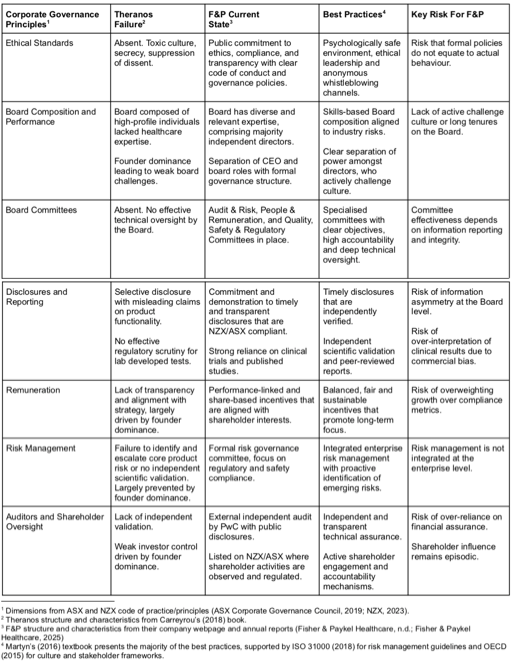
In Table 1, the corporate governance principles stipulated in ASX and NZX are evaluated between Theranos, F&P and best practices. This facilitates gap analysis, and the identification of potential risk and implications for F&P. The implications are distilled into three themes for deeper discussion, before exploring recommendations to strengthen F&P’s governance over both short and long term timeframes in the last section.
It is evident that F&P demonstrates robust governance structures aligned with best practices and ASX/NZX principles. Theranos on the other hand had limited governance structures in place, comprising selective disclosures and a Board with high profile experienced individuals. Even so, Theranos did not exhibit effective governance. This highlights that the key governance risk for F&P isn’t about formal structural deficiencies, but potential misalignment between the existing governance frameworks and operational reality.
Table 1. Comparative analysis of Theranos and F&P corporate governance principles.
Organisational Culture and Development
Theranos’ failure was attributed to a toxic work environment where healthy challenge was suppressed, information was distorted, leading to lack of accurate reporting and escalation of real risks to management and the Board. Although such culture was largely driven by Elizabeth’s leadership dominance, the Board had not fulfilled their responsibility of intellectually challenging the status quo.
The risks for F&P’s Board and committees therefore include their ability to constantly adopt fresh perspectives, openly challenge assumptions, and adjust company strategies by receiving accurate reports on operational performance. It is crucial for the Board to seek continuous development in evolving governance practices to stay relevant. This promotes strategic vigilance, reinforcing the Board’s demand for strict ethical standards and culture while leading by example.
Roles of Shareholders and Stakeholders
At Theranos, founder dominance and limited shareholder influence has led to reduced accountability and weak external oversight. Also, Elizabeth did not have the right technical background in the medical field, which contributed to operational risks being downplayed or intentionally obscured from stakeholders without challenge. Both scenarios were detrimental to Theranos’ sustainability and success. F&P being on NZX and ASX has met both exchanges’ formal requirements to regularly engage shareholders, aligning with governance principles.
However, such engagements are episodic. There is potential to increase shareholder interaction to gain a large pool of broad and intellectual thinking for the betterment of F&P’s sustainability. Likewise, the relevant stakeholder pool in the healthcare industry is very diverse. Creating the opportunity to capture their perspective and curate feedback around issues such as remuneration, audit outcomes, clinical trial performances and F&P’s strategic direction can systematically address the multiple governance risks identified in Table 1. Shareholders and stakeholders therefore provide a powerful external mechanism to enforce accountability and drive continuous improvements for F&P.
Enterprise Risk Management
The proprietary testing technology of Theranos was the single key risk to the company’s survival. It was a revolutionary idea that seemed technically feasible at the beginning. However, the development of the technology lacked transparent scientific validation. In addition, the system’s development timeframes and technical capabilities were overly ambitious. Had controls been implemented to address the implications of such factors, perhaps Theranos’ outcome might have been different.
F&P being in the same field, has set up formal risk governance structures to address regulatory, operational and strategic risks. It is identified that risk management is split between the Audit & Risk, and Quality, Safety & Regulatory Committees. Although such a setup had the intention for clear accountability over different types of risks within the company, vulnerability arises when certain risks are interconnected across the purview of both committees. Such a siloed approach prevents F&P from generating synergy in integrating risk management at the enterprise level, potentially leading to inefficient use of resources or deployment of control measures.
Recommendations for Fisher & Paykel Healthcare
After identifying the governance risks that are applicable to F&P, this section explores recommendations to address and mitigate the risks over both short and longer timeframes. The recommendations are structured similarly across organisational culture and development, enterprise risk management and stakeholder engagement.
Organisational culture and development
In the short term, F&P should undertake a formal assessment of organisational culture, aligned with COSO’s internationally recognised framework, to evaluate whether its control environment and risk culture support transparency, accountability, and effective escalation of concerns (COSO, 2013). In addition, employee engagement surveys and 360-degree leadership reviews can be conducted to supplement the assessment of F&P’s internal culture.
For the Board, governance capability should be continuously strengthened through structured programmes from recognised institutions like the Institute of Directors New Zealand (IoD, 2023). The Board Secretary will identify suitable courses focused on enhancing and enabling board effectiveness, decision-making, and oversight capabilities.
Longer term, the insights from the culture assessments should be reviewed and integrated into F&P’s policies and code of practices, strengthening ethical governance across all levels. F&P’s commitment to transparency and accountability ought to be enforced by engaging an independent and external auditor such as PwC. The Board Secretary will work closely with auditors to follow through on F&P’s commitments, while ensuring the integrity of information flows to facilitate Board agenda preparation and open discussions at the strategic level.
Roles of Shareholders and Stakeholders
In the short term, F&P should create a shareholder/stakeholder feedback register to systematically capture insights around improving F&P’s governance and business sustainability. Such a register should be made transparent, and act as a reference for open discussions at public forums to build public trust and accountability. Additional resources ought to be invested in increasing engagement with stakeholders who interact directly with F&P’s healthcare products. The Board Secretary can identify suitable forums for F&P’s participation to strengthen public engagement efforts.
In the longer term, a transparent evaluation and prioritisation process must be developed and integrated into F&P’s operations. This ensures that the prioritised insights inform the Board to facilitate better decision making around R&D, translating to significant operational improvement for F&P. These recommendations can be actioned upon under F&P’s Corporate arm, supported by the Board Secretary in updating and reporting the feedback register internally for decision making and externally for public accountability.
Enterprise Risk Management
In the short term, F&P should conduct a comprehensive risk review following the ISO 31000 guidelines (ISO, 2018). This is especially critical under the current context of conflicts in the Middle East leading to uncertainties in energy and prices, supply chain disruptions and cyber risks as F&P’s products are increasingly digitalised. An emphasis should be placed on identifying risk interdependencies between the two existing committees (Audit & Risk and Quality, Safety & Regulatory), with the objective of improving coordination and information sharing around common risks. The Board Secretary will support the communication between the two committees, and synthetise a coherent and comprehensive risk profile for the Board’s understanding.
In the longer term, it is recommended that an integrated enterprise risk management committee or department be set up and overseen by a Chief Risk Officer. Such a formal structure enables a holistic view of all risks materially impacting F&P, driving better risk management and alignment with strategic objectives. This also reduces the ambiguity of determining which risk committee is accountable for new and emerging risks over time. The Board Secretary will ensure that key enterprise risks are captured in Board agendas, while ensuring the integrity of the reported risk information.
Conclusion
The Theranos case highlights the requirements for formal governance structures, and that effective governance extends beyond just structural compliance. While F&P demonstrates strong governance foundations, key risks lie in the alignment of operational realities and its formal structures. By strengthening organisational culture, deepening shareholder/stakeholder relations and integrating risks at the enterprise level, F&P can enhance its governance effectiveness, operational resilience and public reputation.
Reference
ASX Corporate Governance Council. (2019). Corporate governance principles and recommendations (4th ed.). https://www.asx.com.au
Becheș, P.-D. (2025). Corporate governance and sustainability in the healthcare industry: The impact of diversity and transparency on social and environmental performance. CECCAR Business Review, 6(3), 2–14.
Carreyrou, J. (2018). Bad Blood: Secrets and Lies in a Silicon Valley Startup. Companies Act NZ (1993). https://www.legislation.govt.nz/act/public/1993/0105/latest/DLM319570.html
Fisher & Paykel Healthcare. (n.d.). Board of directors. https://www.fphcare.com/nz/corporate/about-us/directors/
Fisher & Paykel Healthcare. (n.d.). Corporate governance. https://www.fphcare.com/nz/corporate/sustainability/governance/
Fisher & Paykel Healthcare. (2025). Interim report 2026. https://resources.fphcare.com/content/fph-fy26-half-year-report.pdf
Guerrero, O. A., & Castañeda, G. (2019). Does better governance guarantee less corruption? Evidence of loss in effectiveness of the rule of law. arXiv.
Institute of Chartered Accountants in England and Wales. (2022). Five lessons to learn from the Theranos affair. https://www.icaew.com/insights/viewpoints-on-the-news/2022/feb-2022/five-lessons-to-learn-from-the-theranos-affair
International Organization for Standardization. (2018). ISO 31000: Risk management — Guidelines. https://www.iso.org
Institute of Directors New Zealand. (2023). Governance courses. https://www.iod.org.nz/governance-courses
Martyn, K. (2016). Corporate governance: A practical handbook (2nd ed.). Wolters Kluwer. New Zealand Exchange. (2023). NZX corporate governance code.https://www.nzx.com/regulation/nzx-rules-guidance/main-board-listing-rules
Organisation for Economic Co-operation and Development. (2015). G20/OECD principles of corporate governance. https://www.oecd.org
Szabó, A. (2021). The importance of corporate governance in health care. Journal of Health Administration Education, 38(3).
Transparency International. (2016). Transparency and good governance in global health.
U.S. Department of Justice. (2022). Elizabeth Holmes sentenced for defrauding investors and patients. https://www.justice.gov/usao-ndca/pr/elizabeth-holmes-sentenced-more-11-years-defrauding-theranos-investors-hundreds
U.S. Food and Drug Administration. (2023). Patient advocacy lies at heart of FDA agent’s Theranos case. https://www.fda.gov/about-fda/regulatory-news-stories-and-features/patient-advocacy-lies-heart- fda-agents-theranos-case
Winkler, R., & Weaver, C. (2015). Theranos CEO Elizabeth Holmes has deep control over company. The Wall Street Journal.